
Social media is inevitably intertwined with our daily life. It’s not just for socializing and exchanging photos anymore. Some go as far as to say that it’s slowly edging out normal face-to-face communication. With an impact as deep and thoroughgoing, it’s no wonder that millions fall victims to fraudulent acts each year. Make no mistake, it’s a jungle out there! Not just Facebook, all social media is a hunting ground for hackers and fraudsters. You’re in your right to be looking for a way to prevent identity theft and we are here to assist you with that. Nevertheless, the main focus of this article will be the 7 most dangerous schemes that threaten the average Facebook user.
1. Catfishing
The scheme that never gets old – the so-called ‘catfishing’. That’s crafty exploitation of someone’s desire for an intimate relationship. Catfishing is typical but not exclusive to dating sites and apps. Facebook is just the next step of the evolution of this ancient method for manipulation. Indeed, there’s an epidemic of dating scams. The damage done to Australian internet users tallied up to $42 million in 2016 with the tendency to grow to an even larger figure in the future. ACCC deputy chairwoman Delia Rickard warns:
Don’t ever wire transfer or send money to someone you don’t know because you won’t see it again
 Online security services warn that catfishers know all too well the potential victim’s profile and deliberately search for vulnerable individuals. The criminal would first try to earn your trust, and from there – use that against you to ask for money. The reasons for that will vary, but most of the time will have to do with that person wanting to meet you but supposedly meeting obstacles along the way, which, seemingly, only money can resolve. Don’t fall for the trap! You should know better. Some people go to great lengths in trying to deceive their victims. Bear in mind that experienced ‘catfish’ are capable of doing grandiose stunts with the power given to them by social media and a fair bit of photoshop. But that’s not all, cyber threats come from all angles, so keep reading.
2. The ‘See Who Blocked You’ Scheme
Wouldn’t it be great if you knew who has blocked you or removed you from their friends list on Facebook? Just imagine an application revealing such precious information – it could, no doubt, be used with perfect utility, and would enjoy a massive user base. Scammers are very well aware of that though, and they are ready to cash in on the opportunity to promote their malware that is supposedly there to help you. So how does that work? Usually, it all starts with stumbling upon a flashy advert displaying the message you want to hear with capital letters. Somewhere in plain sight, on the ad banner, is a call-to-action button that initiates the installation of certain software, or shall we say, malware. If you just skim through the installation steps, it would be fair to say that you’ll be in a world of trouble. Such applications, usually request permission to collect information from your profile, send spam at your email address, and even start posting self-promotion advertisements.
3. Winning the Lottery Messages
 That’s a relatively new scheme, the purpose of which is to convince the victim that they have won lottery money. Usually, the spam message is sent via fake profiles that are replicas of trusted accounts such as the ones of Facebook executives. Once the victim has been contacted, they are usually informed that they must send a certain sum of money via a gift card or another form of payment prior to claiming their ‘winnings’. There are reported cases in which cybercriminals solicit money continually, not just once. The reason criminals have success using clever ploys like this one is they leverage the position of trust of big accounts to persuade people to satisfy their absurd demands. Don’t fall for it, it’s crazy to think that a Facebook executive would contact you asking for money.
4. ‘Harmless’ Quizzes
Let’s get one thing straight, most things on the internet that are considered ‘free’ usually have a hidden purpose that’s oftentimes not revealed until it’s too late. Such is the case with the free quizzes trend that’s literally blooming on social media. It’s so easy and tempting to share a quiz with your friends and compare your results. This indeed looks like a fun and engaging activity, but what happens in the meantime is that your and your friends’ information is being extracted. Security experts warn against extreme cases in which quizzes are used as a mechanism that trick Facebook users into subscribing to monthly services. If you have a thing for quizzes, if you think they are the best way to pass the time, the burden to check whether they come from a legitimate source is on you. No one is going to do that for you, and the safety of your personal information depends on it.
5. Investment Scam Can Cost You Dearly
The first misstep people take in this situation is assuming that Facebook wouldn’t approve the adverts of dodgy sites or companies without a solid background. Once you get in touch with the perpetrator, they will ask you for an investment under the premise that now is the perfect time to invest in so-and-so. The pitch used to sell you on the idea to invest could revolve around speculation on the exchange rates of different stocks, currencies etc. In times like this, everyone wants financial freedom and many people let their guard down ready to achieve it at all costs. Free financial advice is usually worth exactly what you paid for it – nothing. You can read the heartfelt story of Kevin Holmstrom who learned to his cost about the harsh reality of Facebook investment scams.
6. Your Facebook Account Has Been Cancelled
This gambit has been plaguing the Facebook community for a while now. In its core that’s a phishing technique, used to get to your private information. In the specific variation we’re going to look at, the victim is asked to resubmit their account information, starting with username and password or else their account is at risk of being cancelled. Correspondence is conducted exclusively over e-mail, which in and of itself should set alarm bells ringing. Of course, compromising the security of your account leaves you wide open to identity theft attempts. What’s the takeaway from this? First of all, it seems very unlikely that a Facebook official would contact you via email. Why not use the platform itself, since that’s the issue at hand? Second of all, admins don’t randomly close user accounts of their own accord. If you haven’t overstepped the rules there shouldn’t be a reason for such drastic measures. So, think about those things next time you journey through the spam folder of your email.
7. Short URLs Leading to Malicious Sites
The tools used to make a URL more compact can be a double-edged sword because the shorter version doesn’t indicate where the link is leading. Let’s first clear the air – not all short URLs are necessarily linked to scam sites, but the format itself is very convenient for cybercriminals to spread links to malicious domains. If you ever happen to click on one of those, you’ll be, most of the time, prompted to start downloading a piece of software that you most certainly don’t need. If the download and installation continue unchecked, this might result in data loss, or account hijacking in the most severe of cases. This flags the issue of whether we should blindly click on random links. If curiosity is killing you but you’re not sure whether a link is safe, you can test its legitimacy with the help of specialized sites like expandURL. Better safe than sorry, isn’t it?
Two Can Play That Game – What happens When You Reply to Spam Messages?
Have you ever thought of fighting back? The average internet user is being scammed on a daily basis, isn’t there something we can do to give the fraudsters of their own medicine, so to speak? It takes two to tango, so it would be interesting stooping to the perpetrators’ level and let the trapper become the trapee. What does that mean? Let’s just say that if you’re sensible enough to tell apart scam from someone with genuine intentions, you can pretend to have taken the bait and make them work for it extra hard. Of course, at the end, you leave them empty-handed.
While this might sound like an underhand technique, it could be regarded as a social obligation because by wasting the time of shady individuals you are preventing them from finding new victims. As James Veitch explains in his TED talk, having the wrongdoers running in circles for two weeks straight was a time well spent. What did the eloquent wordsmith do and what results did his little experiment produce you can see for yourself in the video below.
Psychology of Internet Scamming – Why Are There So Many Fakes?
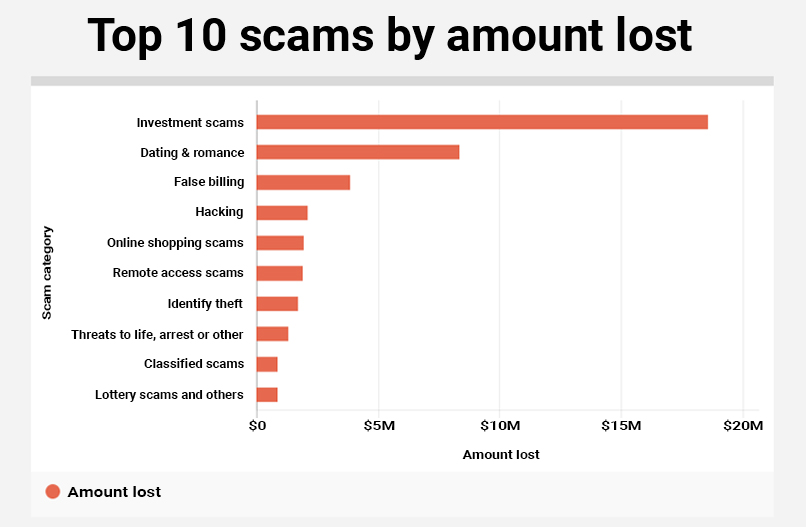
First and foremost, this is a profitable enterprise for the hardened criminals and clever hackers. There are outlaws who live off the average unsuspecting user surfing the internet and are making a good living in doing so. The Australian Competition & Consumer Commission reports a $35 million financial loss in the first quarter of 2019, consequence of online scams. But aside from the obvious, is there another reason for cyber criminals to do what they do? Well, the Internet makes it almost too easy to reach out to other people. So easy that some find it irresistible to send spam mails and messages. Blame it on the internet everyone. In all seriousness though, it’s scary when you think how eagerly people share their personal details and how exposed we actually are to malevolent activity. Don’t make it too easy for those who want to harm you do what they want to do. If anything, by making them work harder you might discourage them from taking action to begin with.